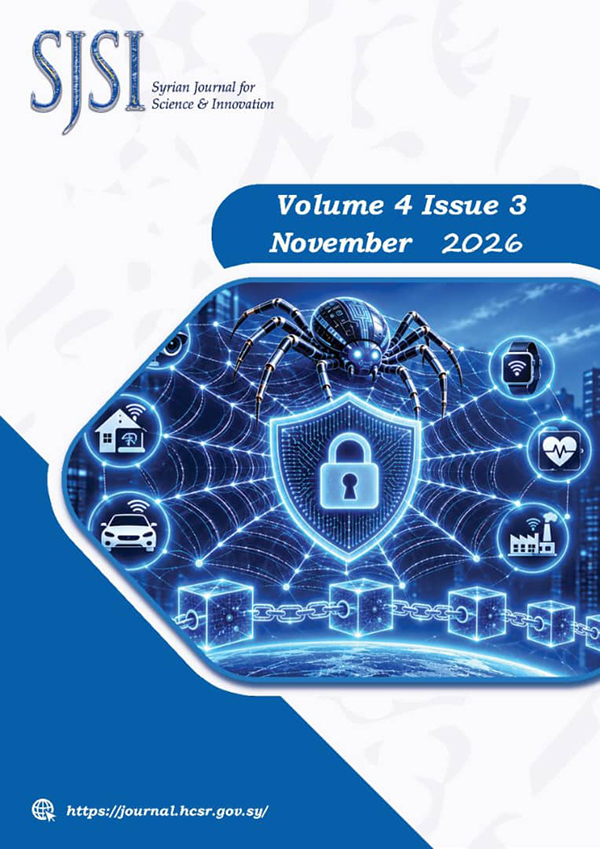
Enhancing IoT Security Using Spider Web-Based Dynamic Keys and Blockchain Encryption
2026-11-05 | Volume 4 Issue 3 - Volume 4 | Research Articles | Razan Rezk | Wasim Al-JuneidiAbstract
The present investigation proposes a novel hybrid security architecture that reconciles robust defense against Denial-of-Service (DoS) attacks with resource-efficient operation within Internet of Things-based wireless sensor networks (IoT-WSNs). The framework synergistically integrates three principal techniques: Spider-Web-based Dynamic Key (SWDK) generation for lightweight cryptographic operations, Principal Component Analysis (PCA) for data dimensionality reduction, and blockchain technology for immutable, tamper-resistant authentication. This model underwent comprehensive evaluation via the NS-3 network simulator, employing a cluster-based topology consisting of one base station and four sink nodes acting as cluster heads, with network densities varying from 3 to 9 sensors per cluster under static node and open-channel assumptions. Performance was assessed under two flooding attack configurations: a distributed, concurrent assault transmitting at 500 packets per second, and a concentrated, high-intensity assault utilizing larger packet sizes (1024 bytes) and escalated rates of up to 1500 packets per second. Empirical findings attest to the pronounced efficacy of the integrated framework; Under distributed attacks, the model curbed the malicious packet delivery ratio to below 14% while attaining a classification accuracy surpassing 93%, thereby reducing the overall attack success rate by 73% to 85%. In the context of concentrated, high-density attacks, although the blockchain layer independently demonstrated only modest resilience, the complete triple-integrated system yielded exceptional latency stabilization, achieving an average reduction of approximately 70% (with observed spanning improvements of 55% to 82%). This security enhancement inherently introduced marginal performance trade-offs, evidenced by a mean throughput decline of roughly 25% and a concomitant reduction in the legitimate Packet Delivery Ratio (PDR). Nevertheless, given the stringent security demands of mission-critical domains such as healthcare and smart infrastructure, this compromise is justifiable. Subsequent research directions should prioritize the optimization of queuing mechanisms, the implementation of adaptive compression protocols, and the periodic renewal of cryptographic key parameters, alongside exploratory efforts toward hardware acceleration and topological scalability.
Keywords : Wireless Sensor Networks (WSNs), Internet of Things (IOT), Data Security Spider Web Dynamic Key, Blockchain, Data Compression, Secure Data Aggregation.
(ISSN - Online)
2959-8591